The phrase “Leave the church in the village” means “keep your feet on the ground.” It is said to have its origins in Catholic processions in which a church congregation crossed the village boundary during its procession, causing resentment in neighboring villages. The congregation, it was then said, should stop bragging, not overdo it, and please leave the church in the village.
On January 13, 2023, I will join a small procession behind a yellow cross, from the village of Keyenberg to the neighboring village of Lützerath, about 3.5 kilometers away. The approximately 30 participants want to send a sign of solidarity and express their displeasure at the destruction of the neighboring village on the edge of the Garzweiler coalfield, which has become a symbol of the global climate movement. Together, they pray and sing for the preservation of creation and a peaceful and non-violent conflict resolution.
Inside and outside – united in prayer
The initiative “Leave the Church(s) in the Village” (KiDl) had invited people to this ecumenical service at the fence under the motto “Inside and outside – united in prayer.” On the third day of the Lützerath eviction, dozens of climate activists are still waiting in squats, tree houses, and an underground tunnel. The hamlet had since been occupied by police and completely fenced in. Access to the church was therefore no longer possible.
The meeting point for the service is at 3 p.m. in front of the church in Keyenberg. Services are no longer held “inside” the church because RWE Power AG has owned the Holy Cross Church since 2019. It is one of the ten oldest documented churches in Germany. On November 28, 2021, it was deconsecrated with the approval of the Bishop of Aachen. Prior to this, the bells from the church tower had been removed. It’s all the more surprising that at the beginning of the service, their old carillon sounds – over loudspeakers, from the still-occupied former rectory.
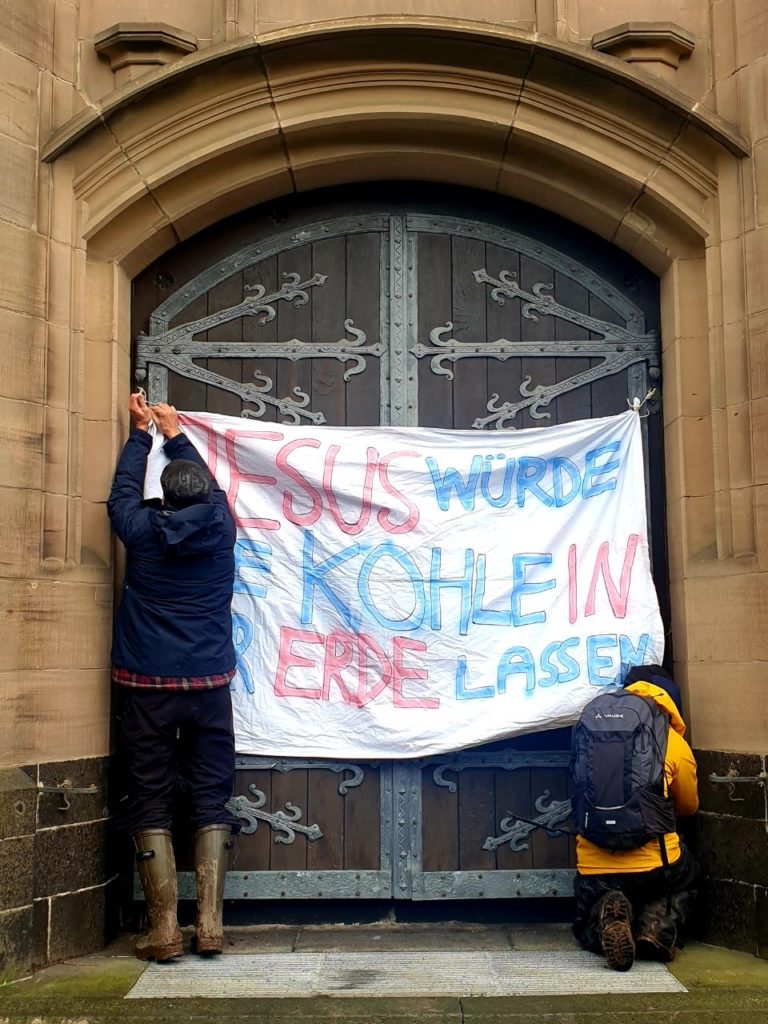
Despite the stormy weather, more than 25 devout climate activists gathered for the service. They decorated the locked church portal with a banner reading: “Jesus would leave the coal in the ground.”
Participants in the procession report that two days earlier, RWE and police forces were among the first to clear the “Yew Chapel,” a place of worship run by the KiDl initiative at the southeastern entrance to the town, on the former L227 country road. There once stood a wayside cross, perhaps also a wayside chapel, as local KiDl members had discovered. Anselm Meyer-Antz, the spokesperson for the initiative, explains that the property was a gift to the Catholic parish in Immerath from the predecessors of the now-displaced farmer Eckardt Heukamp. He had stubbornly resisted the expropriation for years. In the spring, however, Heukamp was forced, with a heavy heart, to sell his farm and farmland to RWE after the Münster Higher Administrative Court ruled in the final instance that the energy company was allowed to excavate his property for open-cast lignite mining. “According to the land register, the property of the Yew Chapel is still the property of the local Catholic parish,” said Meyer-Antz. A handful of believers had watched over the open-air chapel until the very end as a “place of liberating and ecological spirituality,” until they were forcibly removed by police forces.
Watch and Pray for Lützerath
The service is led by Manfred Esmajor, a retired Catholic priest from Aachen. He begins by reading the parable of the fig tree (New Testament, Gospel of Mark, chapter 13, verses 28 ff.), in which he sees parallels to the evacuation of Lützerath. Riding in a wheelchair, he leads the procession from the church onto the L12 country road, past abandoned houses. With a microphone and amplifier on his lap, he sings the Taizé hymn “Stay here and watch with me – watch and pray” – Jesus’ exhortation to his disciples in the Garden of Gethsemane – with the congregation.
Shortly before leaving the village, the procession is stopped by the police to allow a group of climate activists, including members of Greenpeace and Scientist Rebellion, to pass by. They had set out in the opposite direction from the newly established vigil in Holzweiler.
Keyenberg is one of the five villages saved, the preservation of which the federal government, the state government, and RWE agreed to in their 2030 NRW coal phase-out deal. Of the original 900 residents, about 60 still live in Keyenberg. After the break, Esmajor reads the names of the villages that have already been excavated by the Garzweiler coal mines. “Thy kingdom of justice come,” the community responds.
Lützerath marks 1.5-degree limit
On the country road, you can see the RWE excavator inexorably approaching Lützerath, and wind turbines in the distance. Rain and wind whip across the fields. This is precisely where, say climate activists, the 1.5-degree limit runs, which must be defended so that Germany can comply with the Paris Agreement – with the goal of averting global climate catastrophe.
The “Leave the Church(s) in the Village” initiative emerged in 2018 from local resistance against the hostile and climate-damaging open-cast mining. At the time, images of the destruction of St. Lambertus Church, popularly known as the “Immerath Cathedral,” went around the world, and four other churches were threatened with demolition. However, the initiative not only advocates for the preservation of the villages, their churches and chapels, and the fertile farmland in the Rhenish coalfield, but also sees its work as inextricably linked to the fight for global climate justice.
Pastor Esmajor reports from Congo as an example. For the Congolese people and communities with whom he works locally, the consequences of climate change have long been felt. Extreme weather, droughts, and floods are becoming more frequent. In December, at least 120 people died in floods and landslides in the capital, Kinshasa, alone.
At the turning point of the procession, participants have the opportunity to express their concerns and feelings and offer intercessions. One woman recalls the many animals and plants that have lost their habitat in Lützerath, another points out the health risks of open-cast mining due to particulate matter pollution and radioactivity. Some express concern about the harmful effects of RWE’s coal-fired power generation on the global climate, while others express their hope for a moratorium on coal mining below Lützerath.
Talking to each other instead of clearing out
They draw hope from the announcement by Green Party state parliament member and fellow environmental activist Antje Grothus that the currently approved operating plan for the Garzweiler open-cast mine includes land whose owners are unwilling to sell to RWE. This threatens lengthy and legally uncertain expropriations in the planned mining area, even after Lützerath is cleared. “The open-cast mine could come to a standstill a few hundred meters beyond Lützerath until its completion,” she said in the press release published the day before. “The motto now must be: talk, not clear,” said Grothus.
Anselm Meyer-Antz reports that his employer, Misereor, has also taken a stand and called on all parties involved in the conflict to exercise calm. The Catholic aid agency for development cooperation is demanding an immediate moratorium on the eviction from the state government in order to resolve the conflicts of interest between compliance with the 1.5-degree climate target and concerns about security of supply. The interests of the Global South must also be taken into account.
“The main cause of the climate emergency is fossil fuels,” emphasizes Meryne Warah, global organizational director of GreenFaith, based in Nairobi, in the statement. “For the sake of life and to prevent massive, cruel suffering, Africa and the entire world need a binding agreement that stops new fossil fuel projects, phases out existing production, and provides generous support for the transition to a clean energy future and universal access to clean, affordable energy.”
The Yellow Cross: From Gorleben to Lützerath
On the way back to Keyenberg, I chat with Michel Friedrich, a teacher from Wedel near Hamburg, who was active in the anti-nuclear movement as a youth. For him, the nuclear and coal phase-outs go hand in hand.
Friedrich recounts that he and his wife Bina participated in the “Way of the Cross for Creation” from Gorleben to Lützerath in the summer of 2021. An alliance of climate and environmental initiatives, Christian groups, and church institutions called for the pilgrimage under the motto “Anti-nuclear meets anti-lignite.” A 1.80-meter-tall yellow wooden cross was carried in 26 stages, nearly 500 km to the edge of the Garzweiler open-cast mine, past the decommissioned Grohnde nuclear power plant, the Tönnies meat processing plants, the Datteln 4 coal-fired power plant, the RWE headquarters in Essen, and the state government in Düsseldorf. The action drew on the legendary 1988 “Way of the Cross for Creation” from Wackersdorf in Bavaria (site of a potential reprocessing plant) to Gorleben – as an expression of the inner connection between the protests and solidarity of environmental activists at various locations.
On August 1, 2021, the Way of the Cross reached its destination. The yellow cross donated by the Gorleben Prayer was erected at the Yew Chapel in Lützerath. “We are erecting this cross as a symbol of hope against the destruction of creation, which is hardly more tangible than at this gigantic hole,” said Cornelia Senne, theologian and member of the “Leave the Church(s) in the Village” initiative at the time.
Yew Chapel 2.0 – A Sign from God
The discovery of the chapel property overgrown with undergrowth – a 40-square-meter enclosure surrounded by yew trees with four steps – in the summer of 2021 was described by Ralf Meister, Protestant regional bishop of Hanover, as a “sign from God.”
Until a few days ago, regular services were held in the open-air chapel, decorated with the Gorleben Cross, candles, and flowers. The chapel has since been cleared, and the yew trees have been cut down. But its foundation still stands. What happened to the Gorleben cross?
“It was taken into custody by the police,” says Meyer-Antz. According to eyewitness reports, an officer “respectfully” carried the cross away. Efforts are now underway to locate and recover it.
“The chapel was a meeting place for people from near and far who feel connected to the Christian climate movement. It will live on not only in our spirit. There will certainly be an Eibenkapelle 2.0,” said Meyer-Antz.
After the chapel was cleared, Anna-Nicole Heinrich, President of the Synod of the Evangelical Church (EKD), expressed her solidarity with the climate activists in Lützerath in an Instagram post. “In recent months, the Eibenkapelle has been an ecumenical place for all people for silence, for reflection, for prayer. To admire and marvel at God’s creation and to consider how we can treat it responsibly,” wrote Heinrich.
She thanked all those who are “nonviolently committed to climate protection, climate justice, and the preservation of creation. In prayer, on the streets, and in politics. We need places like the Eibenkapelle, which give hope and strength for bold action against the climate catastrophe we are hurtling toward.” Keep the people in check
The procession ends at the church in Keyenberg with a communal prayer and song. The believers in a circle shake hands. Despite the sadness and shock over the aggressive behavior of the emergency services during the clearance, the participants intend to continue their non-violent protest against lignite mining and participate in the large demonstration on Saturday.
Pastor Esmajor invites me to read from the environmental psalm “The Earth Groans” by Monsignor Stephan Wahl as the final contribution to the service, a text I brought with me from Bonn. It is taken from the book “Don’t Expect Pious Sayings from Me.” The final verses of the Psalm read:
“Yet not all betray Your glorious creation.
Strengthen the courageous and the resistant in their loud protest.
Your blessing be with all who, quietly but consistently,
live sustainably, preserving the world where they are.
For children and grandchildren shall also be granted
to marvel at the richness of Your diverse creation.
Blessed are You, Eternal One, Creator of days and nights,
preserve the world and keep mankind in check.”