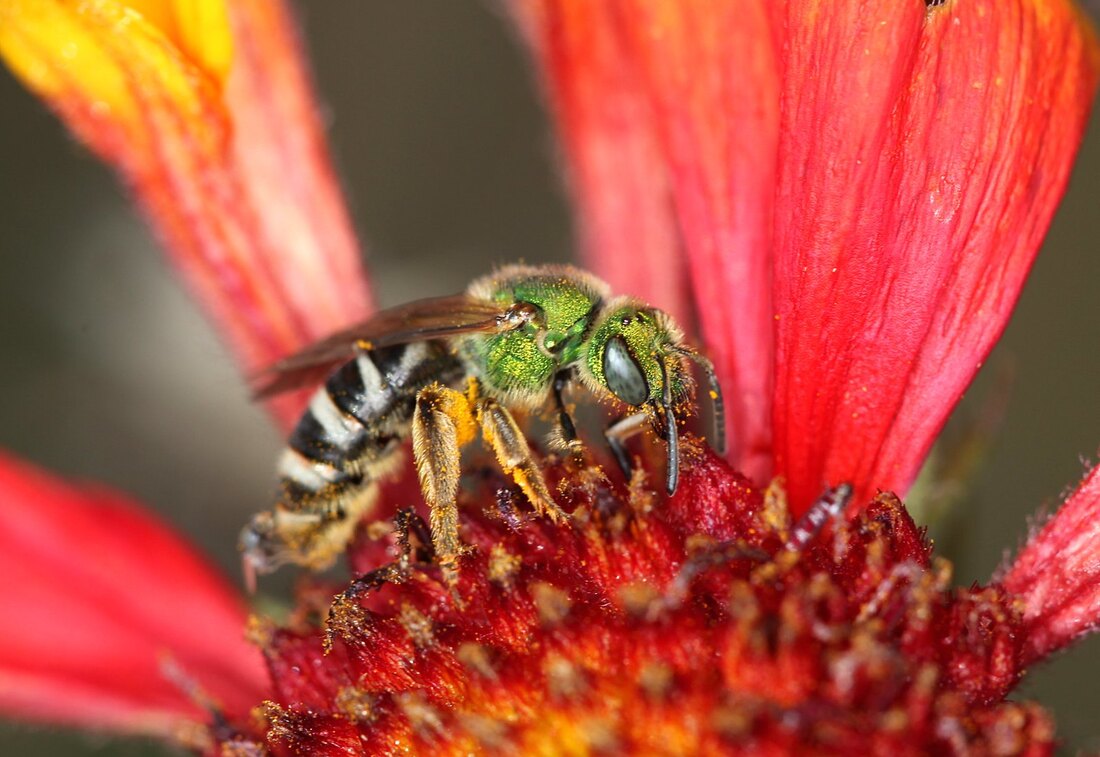
Spring is here, we’re sitting in the garden or even at the outdoor pool, and the flowers are buzzing. While some children are afraid of the black and yellow creatures known as bees, most adults know that they are essential to a functioning ecosystem. Read here why we must protect bees and, above all, what they have to do with interfaith work in the new project “Bees for Peace,” supported by GreenFaith eV.
Why bees preserve our environment
Bees pollinate approximately 75% of the world’s plants that produce food for humans. Fruit, vegetable, and nut trees are heavily dependent on effective pollination by bees – and thus, so are we humans. Bees also pollinate plants that don’t produce food, such as wildflowers, which in turn provide habitat for other animals. Thus, bees maintain the food chains on which all life depends.
“Planetary boundaries are defined for those nine biophysical systems and processes that regulate the functioning of life-support systems on Earth and thus ultimately determine the stability and resilience of the Earth system.” (Potsdam Institute for Climate Impact Research)
Six of these nine “planetary boundaries” have currently been exceeded. These include climate change and changes in the integrity of the biosphere. For this reason, in the “Bees for Peace” project, we want to work together to preserve biodiversity in our habitats and places of worship.
Bees as ambassadors for interreligious dialogue
Our board member, research associate at the University of Cologne, postdoctoral researcher, and activist Dr. Carrie Dohe first launched the “Bees for Peace” project in Canada. Her research focuses on how faith, environmental protection, and climate protection intersect and influence religious traditions. Now she wants to expand the project in Germany.
The project has two goals:
- To increase public awareness and commitment to the protection of pollinating insects and the conservation of biodiversity.
- To promote peace by connecting faith and non-religious communities with each other, as well as with schools, bee conservation organizations, and horticultural experts.
I believe that religious communities have great potential for protecting our shared planet, but don’t always utilize it. Often, they have other concerns. Today, many religious communities are addressing growing social tensions and engaging in interreligious dialogue as a possible solution. Although most religions today possess well-thought-out eco-theologies and knowledge about protecting the environment, this knowledge is not accessible to all members of faith communities. “Bees for Peace” combines a commitment to peace and social cohesion with the scientific insights and practical know-how to easily fulfill their ecological obligations.” – Dr. Carrie Dohe
To help achieve these goals, various initiatives are available: You can book age-appropriate and tradition-sensitive events to educate children about the importance of bees, plan a (interfaith) children’s camp where children develop an understanding of biological and cultural diversity, or create “Paths of Peace.” These are imaginary paths leading from one place of worship to the other. Both communities create a small pollinator garden to attract bees. The idea is that the bees pollinate both gardens, creating a bond between the different traditions, all of which share a common goal of protecting the earth. Bees for Peace thus brings together environmental protection and interreligious dialogue. The project thus creates opportunities for different faith communities or other social organizations that share a common goal: the preservation of our precious earth.
“Bees are messengers of peace: They fly across our self-imposed borders to feed on the flowers in all our communities and unite us in a network of peace. May we follow the bees’ example.” Dr. Carrie Dohe
How can I participate?
If you’d like to be part of Bees for Peace, contact Carrie. Whether as an individual or as a faith community, Carrie would be happy to talk with you.
Carrie Dohe
carrie.dohe@beesforpeace.org
Instagram: @beesforpeace
Web: www.beesforpeace.org/